Turning Blocks of Waste into Buildable Revenue: The Mighty Force of Fieldking’s Balers
An extensive sector that not only ensures food security, fuels economic growth and fosters fiber and raw materials, the agro-industry is also a major source of agricultural residues, green waste and other farm byproducts. Effective agricultural residue management becomes integral not only to improve storage capacity but also to increase optimization and efficiency, enhance safety on farm and take a deliberate step towards earth-conscious practices. A mighty machine such as a baler is used to cut, dry, rake and compress mountains of waste into manageable and compact units of wealth.
A time-tested mechanism, the process of bailing in the agricultural landscape has undergone a metamorphosis of change. From horse powered hay compressing in the late 1800s to automatic pick-up baler machines in the 1930s, to a revolutionary high-capacity automated structure in the 1970s, this machine continues to minimize input and maximize output.
Baler Varieties: Finding the Right Fit for Your Farm
Available in a kaleidoscope of forms, the decision to choose a particular type of baler is not only complex but also confusing. Type of waste material, volume of residue, availability of storage space and budget are some important factors that must be considered during the deliberation process. While all models seek to reach the same destination of stackable blocks of material, their paths differ since their internal mechanics are distinct.
Here’s a comprehensive overview of different types of balers and their specific applications:
ROUND BALERS
This innovative model is a faster alternative to traditional methods and square bales to save time, minimize effort and increase operational efficiency. The waste material and crops like hay and straw are compressed into cylindrical bales with two major advantages; first, they create tightly packed stacks that are weather resistant and can even shed rain, second round balers collect large amounts of crop in a single pass while simultaneously ensuring high quality and low nutrient loss, making it ideal for livestock feeding. A high-octane performer, this machine increases the number of bales produced per year thus leading to better storage and transportation of residues in addition to contributing less to environmental pollution.
Invest in a round baler if:
• You manage your own forage and are looking to feed cattle.
• You seek to collect and compress high quantities of silage, hay and straw, ideal for large scale hay harvesting.
• You wish to store the compacted bales outside, without the worry of damage.
• You are low on labor and are managing small to medium sized operations that require less labor and power source.
SQUARE BALERS
Used to collect loose and dried hay and convert them into tight square shaped bales that are easy to store, stack and transport, this machine is an essential element of modern farming. Square balers operate at optimal speed to create uniform and dense bales and are further categorized into 2 types:
1. Small square balers:
Ideal for marginal farms and small-scale operations, these types of square balers are flexible and versatile, requiring only one person to handle and store it. They not only clear fields rapidly but also maximize transportation speed. The resulting small, rectangular bales usually weigh between 20 to 35 kgs and are fit to feed barn animals in small quantities.
2. Large square balers:
Perfect for large-scale operations and long-distance transport, this type of baler requires machine power for operation and storage. Creating bales ranging between 200 to 350 kg, this machine not only clears large fields rapidly but also maximizes transportation speed.
Invest in a square baler, if:
• You require manageable bales for your farm’s limited storage capacity
• You seek to create organized bales of crops like wheat, rice etc.
• You need efficient stacking and transportation of crop residues
MINI ROUND BALERS
Suitable for small-scale farming and uncomplicated operations, mini round balers create packed bales ranging between 50 to 70 cm in diameter and width. This machine is compatible with smaller tractors and requires just one person for handling and storing, thus making it fit for compact spaces and easy to move hay rolls.
HORIZONTAL AND VERTICAL BALERS
While horizontal balers use horizontal force to create high-volume dense bales, vertical balers have a smaller footprint and employ downward pressure to create low volume bales. While the former machine is used for large farms, commercial operations and high-volume waste, the latter is ideal for smaller farms with moderate waste.
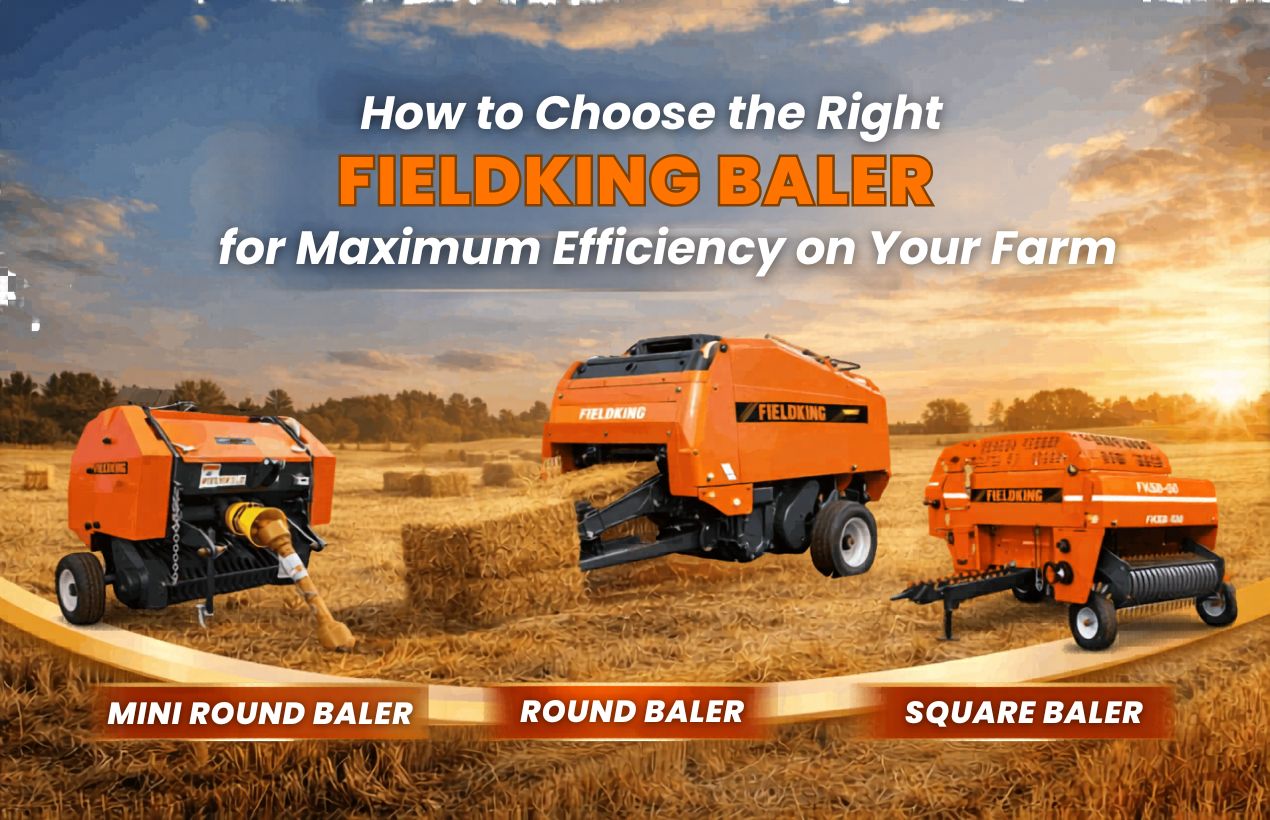
Fieldking, a leading name in the farming industry, offers both square and mini round balers with enhanced waste-crushing abilities that streamline farm operations, ease storage and transportation, reduce environmental degradation and often transform organic waste into useful resources.
Finding Your Farm’s Perfect Baler Match: A Strategic Guide
Taming field waste does not require a universal approach; it’s contingent on factors such as:
1. Crop Type
While both round and square balers are used to bind dry hay and fodder, some high moisture crops such as sileage require only heavy duty balers for effective binding of sticky and wet materials. Stiff and stalky materials of crops like corn require heavy-gauge machines as compared to softer residues that can be managed with lighter versions such as a mini round baler.
2. Storage Capabilities
Storage, space availability and machine size directly dictates the kind of baler one should invest in.
• If you have limited indoor storage space, round balers are your ideal choice since they create bales that are weather-resistant and can be stored outside. On the other hand, if you have an indoor barn space you can opt for square balers that create compact bales that are easy to stack and store.
• Large square balers that create highly dense bales (covering less space) are ideal if you seek to minimize the occupying area. However, if you have plenty of room then you can invest in balers that create low density bales since they take up more space.
• Invest in high-capacity machines only if you have ample storage unit for the same and if not, you can choose lighter and portable versions.
3. Tractor Compatibility
High hydraulic capacity and horsepower of a tractor is ideal for the handling and transportation of large round or square balers. However, if you own a tractor with low horsepower, with no front-end loaders for efficient movement, management and transportation of heavy bales, you should choose mini round balers or small square balers since they can also be moved through manual effort.
4. Farm Size and Volume
Large scale agricultural operations produce more waste, thus requiring more volume of waste to be taken care of, preferably with large automated balers. However, small scale operations produce minimal waste, thus demanding compact machines.
5. Budget
Modern balers boast advanced capabilities that drive up their cost as compared to mini versions that are simple, easy to use and budget-friendly.
Fieldking’s Balers: Creating Perfect Masterpieces
1. Accelerated Efficiency
Assembled from premium quality components, Fieldking’s square baler consists of a feeder with a large diameter and bent prongs that provide continuous and clean pick of materials, eventually producing uniform and stackable bales. The 5 point adjustable compacting setting of the round baler in addition to its sturdy structure makes it a great field clearing mechanism.
2. Designed for Versatility
Employed with striking features such as adjustable length of the bales, flexibility of the drawbar, slip clutch and shear bolt for smooth transmission, our square balers work perfectly even in varying weather and soil conditions. Additionally, our mini round baler can handle various types of residues such as fodder and different crops, coupled with the ability to self-protect the machine from damage caused by overloading.
3. Long Term Value
Engineered with passion and precision, our balers are manageable, safe and reliable machines that curtail space waste, reduce dependency on human labor, lower post-harvest losses and streamline operations to create consistency and productivity for the future.
Fieldking’s baler machine, integral for crop residue management, is a secret weapon of smart agricultural practices that not only reduces volume in no time but also creates value out of it. An embodiment of sustainable farm economy, our baler machines are overflowing with the art of transforming the chaotic farm into a structured field of streamlined operations.
So, invest in Fieldking’s balers that go beyond the binding to set the benchmark of smart farming and systematic yields.