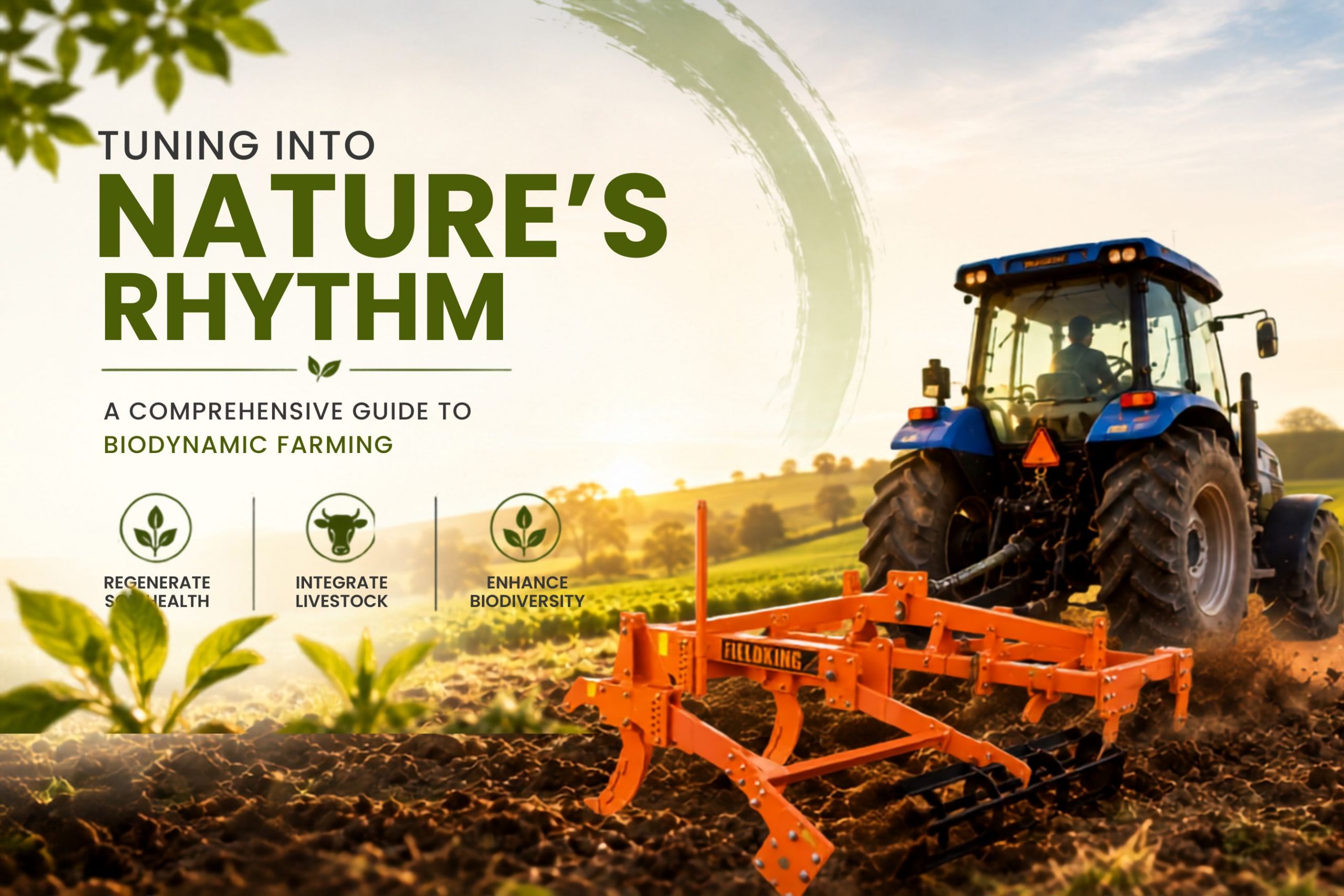
As the heartbeat of our nation, agriculture is India’s life support system – one that goes far beyond putting food on our plates. This living and breathing sector commemorates the marriage of ancient traditions and modern innovation to contribute 18% to India’s GDP and employs over 46% of the total workforce. Serving as the true pulse of rural economy, it sustains environmental health, local cultures, global stability and food chains. Today, farming has evolved into a visionary, future-oriented practice that cultivates a sustainable tomorrow by repairing ecosystems, rebuilding soil health, conserving vital resources by integrating the soil with precision agricultural tools designed to preserve its living structure.
With agricultural roots embedded deep into our country’s cultural, social and financial livelihood, growing a sustainable farming legacy becomes all the more important. The practice of biodynamic farming is one such engine that drives regenerative agriculture and transforms farms into a living, breathing and self-sustaining organism. Let’s deeply analyze biodynamic farming and how it harmonizes the soil with Earth’s natural frequency:
The Art and Science of Biodynamic Farming
Following a uniform rhythm where every component is harmoniously dependent on each other for sustenance, biodynamic farming favors self-sufficiency to infuse more life into the soil than it takes out. This awakening began in the 1920s when agricultural farming was introduced to the wrath of chemical fertilizers and intense mechanization, following which a renowned philosopher named Rudolf Steiner outlined an alternative approach that emphasized agricultural harmony and soil vitality over treating the farm as an industrialized factory of production.
CORE PRINCIPLES and PRACTICES
- A Living Agricultural System: Biodynamic farming is a holistic approach that idealizes the symphony of nature and humanity to regenerate the agricultural system into a breathing, interconnected unit. The farm is viewed as a living organism where every element of the farm becomes a part of a self-nourishing cycle with negligible reliance on external outputs. Creating a closed- loop of self-reliance, biodynamic farming transforms farm’s output and waste into a valuable asset that creates a system of abundance and soil fertility. For example, the farm nurtures the soil, the nutrients in the soil feed the growing plants, the leaf and stalks of these plants are then consumed by animals followed by the excretion of animal waste which becomes the manure that nurtures the soil.
- Biodiversity: Apart from dedicating 10% of the total farm area to biodiversity conservation, biodynamic farming entails the preservation of genetic diversity and building resistance to local diseases and other environmental conditions by prohibiting monoculture and allowing the cultivation of a diverse mix of crops and plants including open-pollinated, heirloom and non-GMO seeds.
- Regenerative Soil Health and Biodynamic Preparation: Replacing synthetic chemicals and standard fertilizers with natural and biological alternatives such as generating rich humus directly in the soil by growing cover crops and applying farm-made compost is a core practice under biodynamic farming. Specialized herbal and mineral preparations including horn manure (made of cow manure) and herbal mixtures (made from oak bark, dandelion, chamomile) are either added to the compost or directly to the soil to create a biologically active ecosystem. This environmentally sustainable practice increases disease resistance, stabilizes physical and chemical structure of the soil and improves crop vitality by stimulating microbial activity within the soil.
- Livestock Integration: This zero-waste system treats animals as essential, active contributors to the farm’s daily cycle. Rather than being confined, different livestock breeds graze systematically across the pastures. By consuming cover crops and forage, they naturally digest organic matter and return it to the ground as nutrient-rich manure. This process feeds the soil microbes, unlocking vital nutrients like phosphorus and potassium to keep the entire agricultural ecosystem in a self-sustaining balance.
- Cosmic Cycles: Biodynamic farming schedules key field activities—like sowing, cultivating, and harvesting—according to lunar and celestial rhythms. Aligning farm operations with these natural cycles optimizes seed germination and plant development, ensuring that precision tools and machinery are deployed at the absolute peak of natural efficiency.
THE UPSIDE
Trading the assembly line production of crop for a closed-loop ecosystem that does not rely on external inputs but rather generates its own vitality, biodynamic farming elevates agriculture into a more refined and aligned process. Let’s explore the earth healing magic of biodynamic farming:
- Peak Harvest Production: Biodynamic farming, rather than creating mass produced commodities, yields produce that bursts with exceptional flavor, taste, aroma and quality. Applying fermented herbal and mineral mixtures and using cover crops for crop rotation with zero dependence on external inputs like synthetic chemicals, creates regenerative soil health which in turn enhances the plant’s nutritional density.
- Environmentally Responsible: A planet-positive approach that is rooted in harmony, breathes in synch with the Earth’s movement and shares a symbiotic relationship with the environment, biodynamic farming heals the planet by restoring its natural flow. By eliminating artificial inputs, using on-farm waste as natural fertilizer, practicing crop rotation and encouraging underground microbial activity, biodynamic farming creates fertile soil that has a higher water holding capacity, makes the soil resilient to floods and droughts besides reducing carbon footprint and the emission of greenhouse gases.
- Economically Rewarding: Pairing premium produce and sustainability with great financial performance, biodynamic farming is a self-sufficient, holistic approach that is not just eco-friendly but also economically sound. With significantly lowered input costs owing to the self-creation of seeds, manure and fodder, creation of stable yields due to a highly fertile and resilient soil structure and commanding high market prices for top-notch quality produce, this approach is great for equity.
- Revitalizing the Roots: The key principles of biodynamic farming stimulate the presence of:
- Stable humus that improves water retention and aeration within the soil.
- Fermented mineral preparations that encourage the existence of beneficial bacteria and earthworm activity.
- Practices like cover cropping that supports soil fertility.
All of these combine to create an ideal environment for deeper penetration of roots, prevent root burn or any damage to the underground network and boost robust root growth.
Rooted in Responsibility: Enhancing Biodynamic Practices with Fieldking
An environmentally conscious partner in nourishing the Earth and planting the seeds for a thriving future, Fieldking offers high-tech machinery that promotes ecological balance and long-term sustainability. Some of our key innovations designed to work in harmony with biodynamic farming are:
- Boom Sprayer: Specially fermented herbal and mineral preparations are essential lifelines for biodynamic soil. Fieldking’s boom sprayer is designed to apply these preparations with steady, low-pressure delivery and biological-friendly nozzles. This ensures uniform, efficient coverage across large areas while keeping the live beneficial microbes in your preparations safe from high-pressure shearing forces.
- Cultivator: Uprooting weed growth and breaking up surface crusts without disrupting the deeper soil food web is where Fieldking’s cultivator shines. As a secondary tillage implement, it aerates the top layer to create a nutrient-rich environment for seedlings to thrive, perfectly aligning with the philosophy of treating the soil as a living, breathing entity.
- Subsoiler: Compacted soil suffocates roots and beneficial organisms. Fieldking’s high-quality subsoiler penetrates deep into hardpan layers to shatter compaction without inverting the soil. This allows air, water and deep burrowing roots to access the subsoil while keeping the microbes in the soil safe and undisturbed.
- Planters: Featuring a wide variety of planters including pneumatic and robust multi-crop row planters, Fieldking pairs engineering precision with ecological design. Supporting the practice of intercropping, mixed cropping and cover cropping, our planters place seeds at the desired depth and spacing with minimal soil disruption. This diverse and uniform sowing process supports natural nitrogen fixation, protects soil structures and helps the farm produce everything it needs to sustain itself naturally.
- Rotavators: Available in various configurations, Fieldking’s rotavator supports biodynamic harmony by acting as a highly efficient crop-residue manager. It gently incorporates organic matter into the topsoil, encourages natural soil respiration and mixes cover crops shallowly to transform them into nutrient-rich green manure. Additionally, this advanced machine creates a perfectly structured seedbed for optimal root development.
Respecting the complex soil food web and honoring earth’s organic cycles, Fieldking’s agricultural implements bridge the gap between modern engineering and ecological wisdom. Manufactured for the modern yet mindful farmer, our precision-engineered tools leave a minimal footprint while enhancing the natural biodiversity of the land.
Nurture your plants, breathe life into your crops and feel the steady, living pulse of your soil with Fieldking’s agricultural equipment, today!