From the food you consume, paper you write on, the favorite cozy wool sweater you wear and morning coffee you savor to the bioplastics casing on your electronic items, the oil in your pigmented eyeshadows, the turmeric in your facewash and the chair you lovingly sit on to eat, agriculture fuels and powers every aspect of your life.
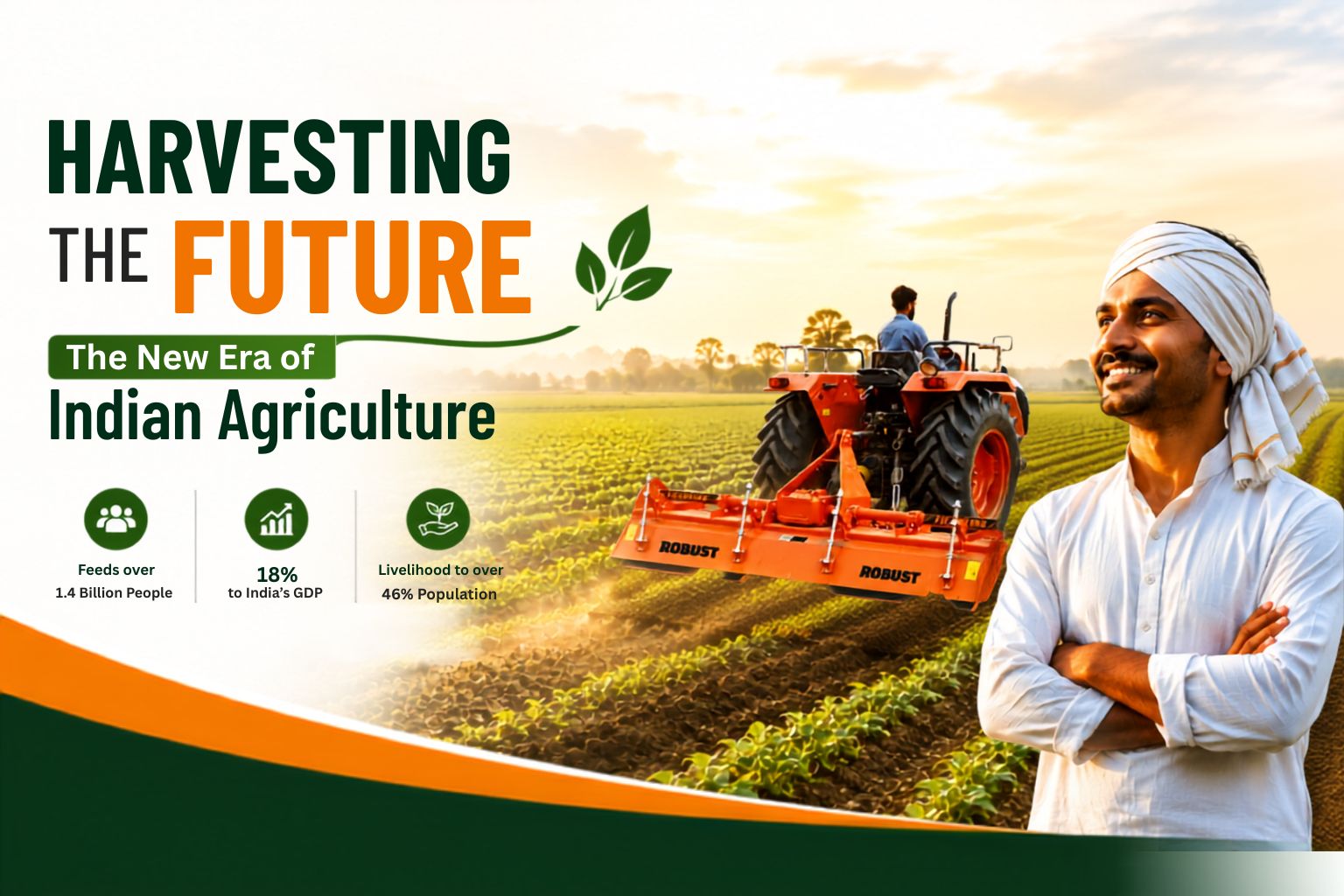
The story of Indian agriculture goes beyond the basics of being “just another sector”; it is a vibrant tale of growth that is woven through the core principles of resilience and sustenance. A dynamic foundation that gives shape to the nation’s future, Indian agriculture feeds over 1.4 billion people, contributes 18% to the country’s GDP, provides livelihood to over 46% of the nation’s population and exports raw materials and agricultural commodities to numerous sectors, both national and international.
Indian agriculture, once heavily dependent upon climate, labor force and the “for survival” ideology, now rests peacefully in the arms of public infrastructure and high technology such as modern equipment and drones. Let’s chart the course of agricultural revolution and green transition as seen in India and how it favorably impacts the nation’s position in the global market.
The Green Palette: Exploring the many faces of Agriculture in India
Subsistence Farming
Subsistence farming is a primarily traditional farming practice where marginal farmers work on smaller than 5 acres of land and rely heavily on manual labor, traditional knowledge, natural resources and low-cost inputs such as simple tools, organic manure, local seeds.
Subsistence farming is divided into two categories: while intensive subsistence farming is characterized by heavy tilling of small plots of land to maximize crop yield, primitive subsistence farming involves slash-and-burn methods.
Centering around personal consumption and self-sufficiency with barely nothing left for market expansion and commercial sale/trade, subsistence farming is a challenging practice that is susceptible to the vulnerabilities caused by changing climate, limited access to credit and modern technologies.
Commercial Farming
Radically transforming the nation’s economy, commercial farming is a market-driven agricultural system that counts on modern implements, high yield variety (HYV) seeds, huge capital investment, large landholdings and precision inputs to maximize commercial yields, increase profits and reach global markets.
Fueling rural employment, industrial growth, international exports and comprehensive revenue, commercial farming centers on growing high yield cash crops such as sugarcane and cotton, plantation crops that includes tea and coffee, oilseeds such as soybean and spices involving pepper and turmeric.
Plantation agriculture is a highly specialized form of commercial farming that entails the large-scale cultivation of a single specialized crop such as tea, rubber or cocoa with the aid of huge financial capital, modern farm equipment and high-value inputs to reach national and international markets, effectively.
However, commercial farming faces many challenges, including fluctuating market prices and demand, environmental degradation and high setup costs that make it difficult for marginal farmers to become an active participant of this profit-making system.
Organic Farming
Highlighting soil health, ecological balance, crop biodiversity and animal welfare, organic farming is a sustainable agricultural system that doesn’t fight but rather works in harmony with nature by swapping toxic chemicals and synthetic fertilizers with organic materials such as natural compost, green manure and crop residue.
As a means to promote diverse flora and fauna, livestock and animal welfare, organic farming practices intercropping and crop rotation that boosts soil fertility and maintains a well-balanced ecosystem.
With low input costs, premium pricing, long-term stability and high market demand for chemical-free produce, organic farming is a regenerative agricultural model that harvests wealth and wellness while simultaneously healing the earth and feeding the people with real and pure produce.
Automating Harvest: How Precision Farming Boosts Productivity
The transition from manual labor to automated brainpower is defined by a journey of digital transformation, sustainability, resilience and precision. This paradigm shift is characterized by:
Precision Agriculture
• Data-driven farming uses advanced tools such as GPS, drones and satellite imagery to monitor on-field conditions and variations so that the farmer can carefully apply the right amount of water, pesticides etc.
• This targeted strategy not only cuts input waste by 40% to 60%, but also minimizes environmental impact and maximizes yields.
• This sustainable approach honors individual farms, their unique soil profiles and distinct landscape to create a global tapestry of sustainable food production.
Modern Machinery
• Advanced farming equipment has completely transformed agriculture; from the blood, sweat and tears of manual labor to science backed field implements that allow farmers to plant and harvest crops precisely and efficiently, the technological leap in the agricultural sector has given birth to smarter farming.
• Automated harvesters, targeted ploughs, precise sprayers and advanced balers have all come in unison to optimize crop yield, minimize environmental impact and reduce post-harvest loss.
Artificial Intelligence (AI)
• Analyzing soil health, presence of pests and diseases and nutrient deficiencies to carefully plan the optimal time to harvest and decide fertilizer/pesticide requirement is now easy due to AI.
• These precise and targeted insights create Agri-intelligence that not only speeds up the farming process but also optimizes the use of resources and increases productivity.
Technology surely has played the biggest part in driving agriculture towards modernity but government backed policies and initiatives still remain the engine and safety net of this innovative car.
Key Government Schemes Catalyzing Agricultural Growth in India
1. Income assistance and financial aid
The Indian government has the farmers’ back, through it all!
Whether one needs direct income support, crop insurance, subsidized credit or security against unavoidable situations such as natural calamities, the government lends a helping hand through the means of various initiatives.
While schemes like Kisan Credit Card (KCC) Scheme, provides farmers with affordable access to credit to aid farming activities, others like Pradhan Mantri Fasal Bima Yojana (PMFBY) secures the farmers who are suffering from financial loss due to crop damage caused by unpredictable weather, pests and other diseases.
2. Price Support
Today, market fluctuations cause financial distress to the farmers that not only jeopardize the current harvesting season but also destroy the success rate of the future.
Mitigating the risk of such a financial rollercoaster, the Indian Government has launched schemes like the Minimum Support Price (MSP) that fixes an MSP for 23 mandated crops and in situations where the market prices fall below the set MSP, the government procures the crops from the farmers so that they don’t suffer from any loss.
3. Technological empowerment
To make farming a rewarding endeavor, the use of modern equipment and machinery such as a powered tractor, plough, combine harvester etc. is essential.
The Indian Government promotes efficiently engineered technology through various schemes such as Sub-Mission on Agricultural Mechanization (SMAM) that provides financial support and subsidies to farmers for the purchase of these field powerhouses.
Another innovative initiative to empower technological progress in the agricultural community is the Custom Hiring Centre (CHC) scheme that provides farmers with modern farming equipment on a pay-per-use basis.
Fieldking: Enhancing the Field, Engineering the Future
Unmatched harvesting comes with unconventional tools that have the power to turn your financial burden into financial freedom.
Empowering your farming operations, from tillage to harvest, Fieldking is the perfect partner to take your farm yields to a record-breaking high.
From advanced seeders, dependable balers and precise planters to efficient combine harvesters, high-capacity tankers and heavy-duty rotavators, our farm implement lineup supports successful crop cycle, all year round!
Driven by enduring strength, defined by precision and engineered for efficiency, Fieldking’s agricultural equipments are a true living proof of our promise to empower every harvest.
Build the foundation of your farm’s success with Fieldking’s modern agricultural machinery, today!